

GDP = Consumption + Investment + Government Spending + (Exports – Imports)
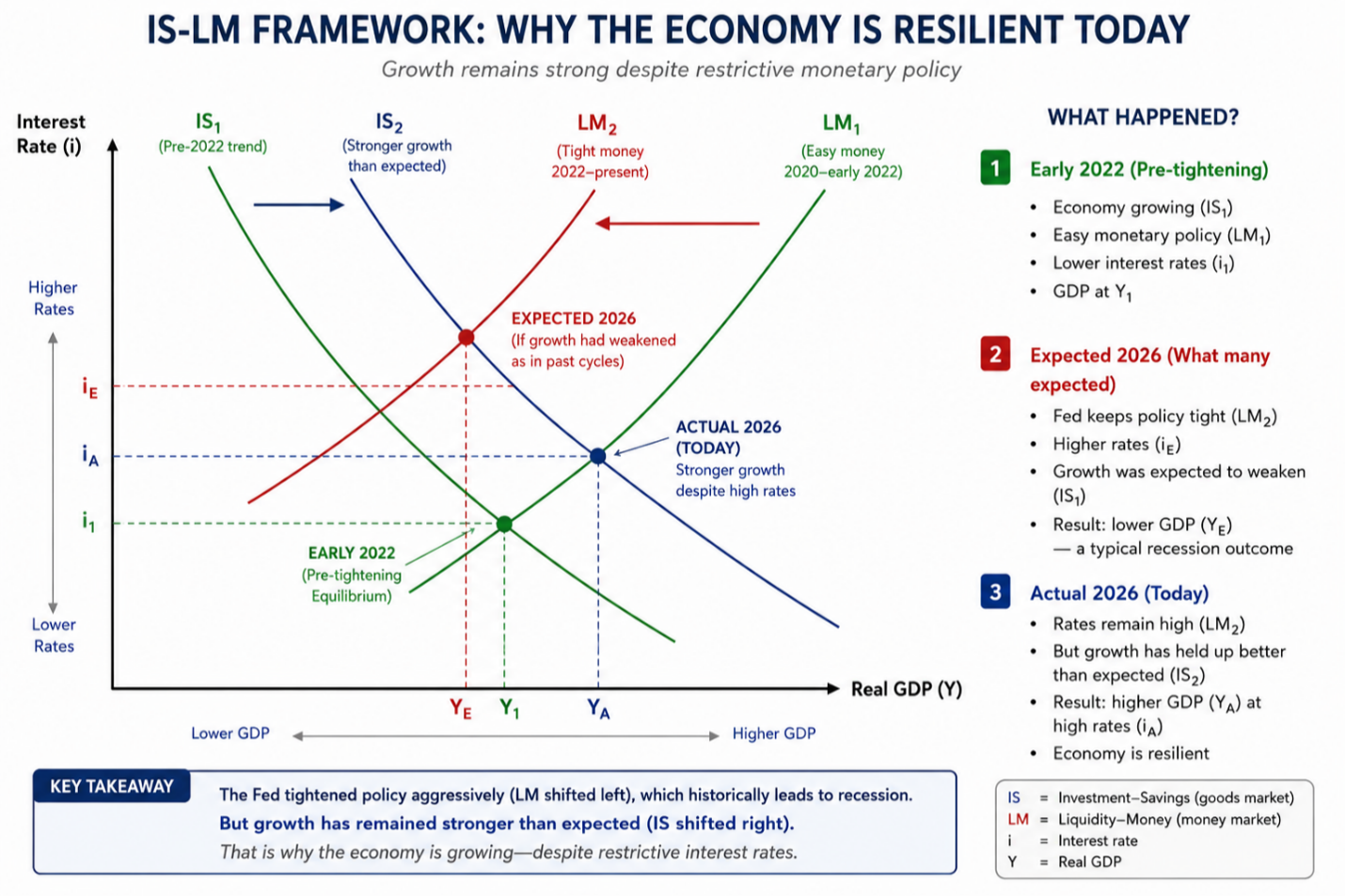
The IS-LM framework below illustrates how the economy has evolved over the past several years. Beginning with the intersection of the two green lines, the economy in early 2022 was characterized by relatively low interest rates and strong growth. Consumers enjoyed inexpensive mortgages, businesses could borrow at attractive rates to expand, and economic activity was robust.
As inflation accelerated, the Federal Reserve responded by raising interest rates aggressively. In a typical economic cycle, higher interest rates reduce borrowing, slow consumer spending and business investment, and ultimately weaken economic growth -- That is not what happened this time.
Source: N. Gregory Mankiw, Principles of Economics, 10th ed. (Cengage, 2024). Current economic interpretation by Gottfried & Somberg Wealth Management.
Instead, economic demand has remained remarkably resilient. Consumers have continued to spend as employment has stayed strong. Businesses are investing unprecedented amounts of capital to build AI infrastructure—including data centers, semiconductors, and electric power. At the same time, federal government spending remains elevated, with annual deficits approaching $3 trillion.
As a result, today's economy is operating at a higher level of economic activity than many economists expected despite significantly higher interest rates. The chart illustrates this by comparing the expected economic outcome after the Federal Reserve's tightening cycle with the actual outcome. Rather than slipping into recession, the economy has continued to expand, demonstrating an unusual degree of resilience.